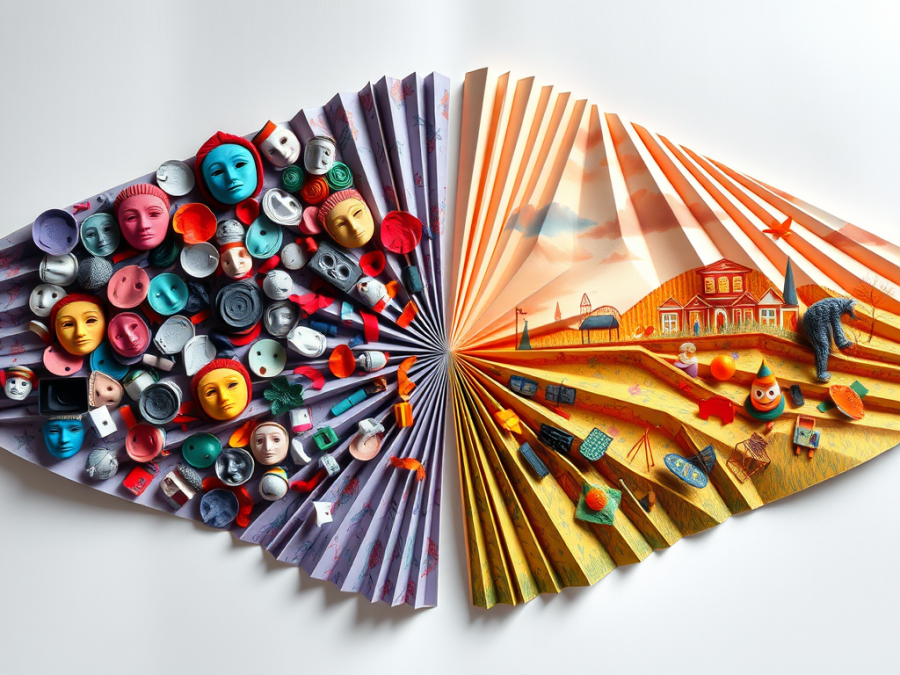
I sit in front of my laptop, driven by an almost obsessive passion to write about a part of my life that constantly imagines an alternate reality. By “alternate,” I don’t mean fictional—it’s a reality filled with hopes, dreams, and prayers. After all, everyone’s life has one, and we’re all masters at hiding behind a mask called Reality.
This is a delicate and somewhat controversial topic, and I may risk sounding ridiculous—but the core message is simple: never lose yourself.
Something happened last night that made me reflect deeply. I was watching the movie Bombay with my daughter. The film depicts the violence that erupted in Mumbai following the Babri Masjid demolition—a time when hatred spiraled between Hindu and Muslim communities. As the movie played, I was explaining the historical context to her, answering her questions as best as I could.
Then she paused, looked up at me, and asked something that stopped me in my tracks:
“How ridiculous is this? What did all these people do? They weren’t even the ones who demolished the religious site, so why are they killing each other? Why couldn’t they even think once that they were destroying their own families and small children, all in the name of a God who is supposed to guide us toward good?”
I knew I couldn’t sugarcoat the reality for her. So I told her the truth: that this was a case of politics masquerading as religion, that it took decades to reach a verdict, and that hopefully, we could move forward and live in peace.
Her next question hit me even harder:
“How can we forget this? This is our history, and we should learn from it. Why aren’t our history lessons teaching these important things? Why do we only learn about things that seem irrelevant to our current society?”
I paused and reflected. Here was a 12-year-old, thinking clearly, basing her understanding on truth—not an alternate reality. And yet, a large section of our society seems hell-bent on pushing versions of history that suit their narrative—a concoction of lies that we’ve begun accepting as truth.
How many of today’s parents are teaching their children that every religion ultimately guides us toward the same path of goodness? Instead, we often encourage them to believe one God is more powerful, more true, or more righteous than another.
We need to guide the next generation toward the right values, or we risk losing the right to call ourselves the generation that made a difference. Yes, we can boast about inventing AI, supercomputers, and electric cars—but if we fail to nurture empathy, understanding, and truth in the next generation, what real progress have we made?
Truth doesn’t compete with lies—it simply exists. Everything else we say, do, or write is merely an alternative reality.
So here’s my plea: let’s help our children learn the truth. Let’s help them see beyond fabricated narratives. Let’s teach them that knowledge, compassion, and understanding are more important than proving who is right or wrong. Because nothing else will make their world—and our world—truly real.
For a better society,
KC.
 MyLifeGasam